
'Now the institutions which have the might of law invested in them think that whatever they do is right.'

'The BJP has all the instruments with them and they do have a sense of purpose, so I don't think there will be a challenge.'

The All India Tennis Association (AITA) has announced its commitment to transparency and inclusiveness following a Delhi High Court decision regarding its 2024 elections. The AITA plans to implement constitutional amendments and ensure player representation in its governance.

The BJP and opposition parties are engaged in a political battle over the implementation of the Women's Reservation Act, with the BJP defending it as historic and the opposition accusing the government of delaying its notification and using it to push an unconstitutional delimitation exercise.
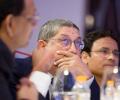
Former BCCI president Shashank Manohar has said that the amendment of the BCCI constituition in 2012 regarding president's post was done to ensure that BJP heavyweight Arun Jaitley became board chief in 2014 instead of N Srinivasan going for a second term.

US President Donald Trump has signed two executive orders aimed at cracking down on 'birth tourism' and limiting eligibility for birthright citizenship, weeks after the Supreme Court rejected a similar directive.

The Tamil Nadu Assembly has adopted a resolution, moved by Chief Minister C Joseph Vijay, urging the Union government to permanently fix the Lok Sabha strength at 543 and implement 33 per cent women's reservation by 2029. The resolution also opposes delimitation that could disadvantage states successful in population control.

The Lok Sabha is set to expand to 815 seats, with 272 seats reserved for women, according to Union Law Minister Arjun Ram Meghwal. The move aims to implement the women's quota without disadvantaging men or any state. The proposed legislations also include provisions for reservation for women from SC and ST categories within the women's quota.

Mirza Fakhrul Islam Alamgir, secretary general of the ruling Bangladesh Nationalist Party (BNP) and a close ally of former premier Khaleda Zia, has been elected as Bangladesh's new President in the first contested poll for the post in 35 years.

Former Rajya Sabha member Saket Gokhale has alleged that the Election Commission refused to disclose details of Chief Election Commissioner Gyanesh Kumar's official visits and the expenditure incurred from public funds, citing 'personal information' under the Right to Information Act.

The government has released a set of FAQs to address concerns and clarify the details surrounding the Women's Reservation Bill, which aims to provide 33 per cent quota for women in legislatures.

Rahul Gandhi accuses the government of using the women's reservation bill as a smokescreen to manipulate India's electoral map and diminish representation for certain states.

Farmers under the Samyukta Kisan Morcha have initiated a week-long protest at the Chandigarh-Mohali border, demanding a minimum support price (MSP) based on the C2 plus 50 per cent formula, debt waivers, and opposing the proposed India-US trade deal, Electricity Amendment Bill, and Seed Bill. They also raised concerns about water depletion and sought resolutions based on riparian principles.

Maharashtra's Transport Minister Pratap Sarnaik announced a drive against auto-rickshaw and taxi drivers lacking a 'working knowledge' of Marathi, with penalties ranging from licence suspension to cancellation, sparking fears among non-Marathi speaking drivers.

Amid renewed speculation about political realignments and a potential merger, senior leaders from two Nationalist Congress Party (NCP) factions met Maharashtra Chief Minister Devendra Fadnavis. NCP (SP) working president Supriya Sule clarified her party's position on the proposed Delimitation Bill, stating that while a uniform 50 per cent increase in seats across states would be hard to oppose, any final decision would be made after discussions within the INDIA bloc.
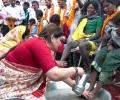
Members of various tribal communities gathered in Delhi to demand the de-listing of converted tribals from the Scheduled Tribe category. The event, organised by the RSS affiliate Janajati Suraksha Manch, saw participation from around 1.5 lakh people from over 500 tribal communities.

The article details instances where the Narendra Modi government has yielded to public and political pressure since 2014, leading to policy reversals and ministerial resignations. It highlights the recent resignation of Education Minister Dharmendra Pradhan over the NEET paper leak, alongside past events like the withdrawal of land acquisition amendments, M.J. Akbar's resignation, the repeal of farm laws, and other policy retreats.

A complaint has been filed against a woman who confronted Maharashtra minister Girish Mahajan over a traffic jam caused by a BJP rally in Mumbai, police said.

Maharashtra Transport Minister Pratap Sarnaik announced that autorickshaw and taxi drivers will be given an opportunity to learn Marathi before any action is taken against them for non-compliance with the language requirement. This move softens the state's earlier stance, which had evoked mixed reactions and concerns about livelihoods.

The changes suggested include the amendment to the provisions of the Constitution relating to preparation of the electoral roll by the Election Commission of India in consultation with the State Election Commission(s) for the elections to the local bodies (in Article 325).

Prime Minister Narendra Modi has announced comprehensive reforms in the education system to combat paper leaks, following the passage of a new anti-paper leak law. He asserted that there would be no leniency for those involved in examination irregularities, highlighting the government's commitment to ensuring fair opportunities for students.

The Bharatiya Janata Party, on the first day of its national executive meet, unanimously passed a resolution to amend article 21 of its constitution to enable incumbent party president Nitin Gakari get a second term. Prasanna D Zore and Ganesh A Nadar report.

India is set to introduce a new amendment to its anti-paper leak law in the Lok Sabha, aiming to establish fast-track courts across all states and union territories for swift trials and significantly harsher penalties for exam malpractices, including jail terms of 5 to 10 years and fines up to Rs 50 lakh for individuals, and up to Rs 10 crore for organised crimes.

It also aims to reduce the powers of the Supreme Court, with some authorities shifted to the proposed Constitutional Court, and immunity to the president from criminal proceedings for life.

Amidst widespread student protests over the NEET paper leak, the Indian government has introduced the Public Examinations (Prevention of Unfair Means) Amendment Bill, 2026, in the Lok Sabha. The bill proposes significantly stricter punishments, including jail terms of up to 10 years and fines of up to Rs 50 lakh for individuals involved in paper leaks, and up to Rs 10 crore for organised crimes, aiming to enhance transparency and fairness in public examinations.

The Congress and BJP are engaged in a political spat over the implementation of the Women's Reservation Bill and its proposed link to delimitation, with Rahul Gandhi urging unconditional implementation of the 2023 law and Kiren Rijiju highlighting the constitutional requirement for delimitation based on post-2026 census figures.

The Congress party in Haryana boycotted a special session of the state assembly, accusing the ruling BJP of using the platform for political propaganda related to a defeated Constitution amendment bill on women's reservation. The BJP criticised the Congress's move as anti-women.

According to a bulletin issued on Wednesday, 'The Constitution (One Hundred and Thirty-First Amendment) Bill, 2026', 'The Delimitation Bill, 2026' and 'The Union Territories Laws (Amendment Bill), 2026' will be introduced and debated for passage in the Lower House.

The Supreme Court, hearing pleas on the Shiv Sena split, observed that a political party retains control over its legislature wing and its valid decisions must prevail, but also advocated for granting 'elbow room' to elected representatives for political decisions if a majority 'genuinely disagree' with party directions.

More than half of the bills introduced in the 18th Lok Sabha have been passed by both Houses in the same session, a significant acceleration compared to previous terms, raising concerns about the time available for legislative scrutiny and stakeholder consultations.
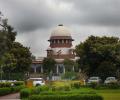
The Supreme Court of India has dismissed a review petition challenging its earlier verdict that a person from a Scheduled Caste (SC) community loses their SC status upon converting to a religion other than Hinduism, Sikhism, or Buddhism, effective from the moment of conversion.
The Supreme Court has sought responses from the Centre and state governments on a Public Interest Litigation (PIL) advocating for the confiscation of movable and immovable property belonging to individuals and their family members involved in exam question paper leak cases. The plea also calls for invoking various anti-corruption and financial crime acts against perpetrators and suggests consecutive sentencing for such offences.

The Maharashtra government has extended the deadline for autorickshaw and taxi drivers to acquire working knowledge of Marathi by one year, a decision welcomed by unions who say it removes the immediate threat to their livelihoods.

Both Houses of Parliament were adjourned sine die, concluding a Budget session marked by the passage of key legislations and the defeat of a Constitution amendment bill on women's reservation. The session saw frequent opposition protests and discussions on various issues, including the West Asia conflict.

The Indian government plans to introduce a bill in the Rajya Sabha to make obstruction or insult to the national song 'Vande Mataram' a criminal offence. This amendment to the Prevention of Insults to National Honour Act, 1971, aims to grant 'Vande Mataram' the same statutory protection as the national anthem, 'Jana Gana Mana', with penalties up to three years' imprisonment.

Parliament on Thursday passed a bill to amend the anti-paper leak law to introduce stricter punishments, with the government expressing its commitment to go the extra mile to safeguard the interests of students, who are the country's future.
Opposition MPs and transgender rights activists are calling for the withdrawal of the Transgender Persons (Protection of Rights) Amendment Bill, 2026, citing concerns that the proposed changes could dilute the rights of transgender individuals.

NDA leaders have defended proposed amendments to the Women's Reservation Act and the Delimitation Bill, 2026, arguing women have waited long enough for reservation, while opposition parties allege the process could undermine India's federal and democratic structure, particularly impacting southern states.
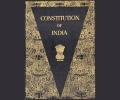
India's Constitution is far more than a supreme legal framework for ideal governance. It is a living chronicle.

'They want to sabotage the caste census and bury Muslim backward classes, Hindu backward classes, Sikh backward classes and Buddhist backward classes.'
